Sunday, 18 November 2012

Leaf Collection

There are a lot of leaves in our house. There are a lot of leaves in our car. There are a lot of leaves in Beans' and Bunny's backpacks, because that's what the mesh pockets on the side are apparently for - leaves. A few leaves have even been through the washing machine, which I suppose is better than the rocks and dandelions that went through it all summer.

A little Beans with a lovely oak leaf


We're lucky to live somewhere with a beautiful autumn. People travel from around the world to see fall in central Ontario. Reds, golds, oranges, yellows (yes, it's different than gold) and browns and the hilly landscape gives spectacular views. This fascination with colourful leaves starts early and often manifests itself through obsessive leaf collection. Because you never know when you might see another red leaf quite as pretty as that last one. And of course you then need to glue it to something.


A little Bunny with a lovely oak leaf

You can see the question coming can't you.

Why do the leaves change colour and why are they all different colours?

So leaves start out green because of the chlorophyll, which is what plants use for photosynthesis to make up their food stores. Basically it helps them turn sunlight into sugar. I wish I could turn sunlight into sugar. No, wait, I wish I could turn sunlight into dark chocolate (which I suppose cocoa trees actually do already). There's usually so much chlorophyll you don't see anything else. Leaves also have other pigmented things in them - carotenoids (yellow/orange), tannins (a waste product - brown) and anthocyanins (produced later in the season - red/purple) but there is usually so much chlorophyll that these other colours don't show up. As the days get shorter the plants slow down their food production and the chlorophyll breaks down allowing the other pigments to show through.

Cool fact: A banana turing from green to yellow is the same process - losing chlorophyll to reveal the yellow colour!

The change is triggered primarily by the shortening days. The longer nights mean less sunlight to produce the sugars and slows the chlorphyll production. Leaves are pretty delicate - they wouldn't survive the winter here which is why at these lattitudes they go through the whole process of shutting down and losing their leaves only to grow them again in the spring. A good example of this is if you have your fridge up too high and the lettuce freezes - pretty useless wilty stuff. It's not all for naught though - the leaves decompose providing nutrients into the soil. Nature is pretty good at not wasting. There is some speculation that the anthocyanins in the soil from decomposing leaves will supress plant growth in those areas leading to less competition for the tree the next year. Not bad, nature, not bad at all. And on top of all that the leaves can provide some good habitat too.


The actual colours themselves depend on what and how much of the pigments are in the leaves. The anthocyanins are not produced throughout the year though and are only present in some species and at different levels - which is why they don't all go red and we get the great variation. Yellows and oranges are already present and revealed as chlorophyll lessens. The type of summer and fall weather can have an effect on the production of these pigments as well, which is why some falls have more vibrant colours than others. A dry, sunny fall with temperatures that stay above freezing at night produce brighter colours. Species wise - oaks vary from reds to browns, aspen, poplar and birch go yellow; dogwood goes red. Maples vary - red maple not surprisingly goes bright red and sugar maple a more orangey-red. Sumac goes a lovely fiery red, which is why I plan to plant some next year.

I'm a bit late on this one as the colours have already pretty much finished here for the year, but if you happen to be around here Ontario Parks tracks leaf colour and timing in their parks - Fall Colour Report

So while we do have an abundance of crunchy leaves in the car, it doesn't lessen my love for the fall colours. I've been known to glue a few leaves to stuff myself.


References:
http://www.na.fs.fed.us/fhp/pubs/leaves/leaves.shtm
http://en.wikipedia.org/wiki/Autumn_leaf_color
http://news.nationalgeographic.com/news/2004/10/1005_041008_fallfoliage.html
http://scifun.chem.wisc.edu/chemweek/fallcolr/fallcolr.html

Sunday, 4 November 2012

Fantastic Fall Fruit!


Bunny is a pumpkin fanatic – pie, ice cream, muffins, roasted seeds, jack-o-lanterns...even she’s impressed with their versatility. Beans is currently obsessed with apples, but don’t mess with them – just whole please. This sparked a debate on what was fruit versus vegetable and the realization that what things actually are is not what we call them.

In the botany world pumpkins and apples are both fruits, even though in culinary terms pumpkins and their squashy relatives get called vegetables. This happens a lot – there’s quite a disconnect between what we call things in food related terms versus their actual botanical classification. In the plant world not all fruits are edible, but I would assume that chefs don’t bother classifying inedible things. For example dandelion fluff and maple keys are both fruits.

Fruits, in plant science terms, are the parts of the plant that are formed from the actual flowers and ovaries. Once the flowers are done and pollinated they magically (ok not really, science only seems like magic sometimes) turn into fruits.


Fruits serve a specific purpose – spreading seeds around. That can happen by a variety of methods - floating around (milkweed), sticking to your socks and travelling (burs) or being eaten and carried by various animals and being dropped (or pooped!) elsewhere (apples!). Because of these relationships fruit and animals are dependent on each other – this is a symbiotic relationship (any relationship where we get pie is good in my books).

Beans being symbiotic with an apple

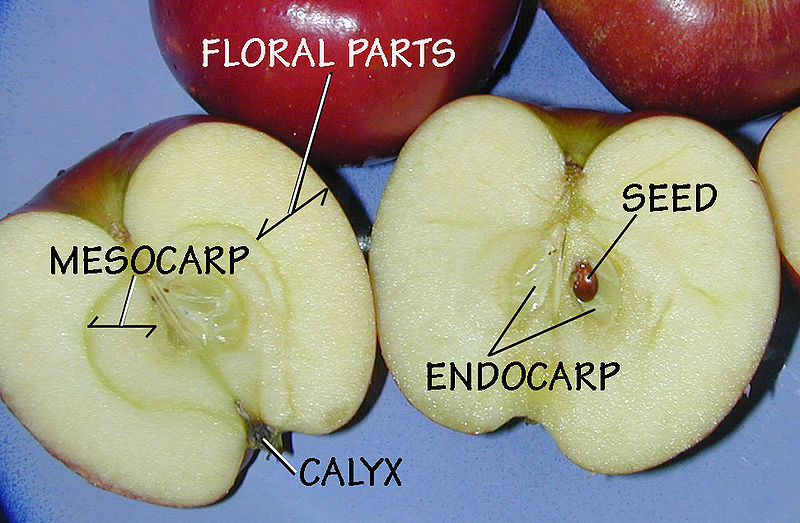
Apples are in the family Rosacae and are a fleshy, simple fruit called a pome. The core is actually the important part to the plant formed from the ovary, the delicious part we eat is just extra tissue from the flower petals and sepals that fuse with the ovary wall that evolved to make us want to eat and disperse.

The ovary forms three parts – the endocarp surrounds the seeds and is hard, the mesocarp is next and is fleshier, the exocarp (not pointed out in these pictures but you can see the line) surrounds that and together they form the core. We eat the hypanthium that surrounds the whole deal, and sometimes accidentally we eat parts of the hard endocarp and spit them out dramatically (at least Beans does).  


Pumpkins are the fruit of Cucurbitaceae plants. The fruit is actually a modified berry called a pepo that has a thick outer rind. Berries are simple fruits where the seed and flesh is formed from a single ovary. Other common berries? Avocado, watermelon, blueberry, cranberry and tomato. What’s not a berry? Strawberry (accessory fruit), cherry (drupe) and raspberry (aggregate fruit). So once again what we call things in real life versus what they are botanically makes no sense.

Bunny’s very first no help at all carved Halloween berry

I can’t find a decent picture of the parts of a pumpkin so here’s a watermelon, just to prove it’s a berry, because I got a seriously unbelieving face from Bunny. She was quite willing to accept that pumpkins were a berry but watermelon was a little out there for her. Same deal though – the ovary forms three parts but in this case there is no surrounding tissue that forms the edible part (why it’s a berry and not a pome). The part we eat here is the mesocarp and the exocarp is the hard rind that makes an excellent jack-o-lantern. The endocarp isn’t shown in this one but it’s there surrounding the seeds.


We all agree though, no matter what you call them – they are still delicious. So whether cooked or raw, pie or plain – we will continue eating lots of fantastic fall fruit (I just wanted to do the alliteration again).

Thursday, 25 October 2012

Water.

It’s the deceptively simple questions that always trip you up.

It rained yesterday. I would have been happy to explain the water cycle or re-answer Beans’ question on the composition of clouds for the fourteenth time (water not fluff – she remains unconvinced) or even take a stab at how plants use the water. At 7:45am what I was unprepared to answer was Bunny’s question.

What is water made of?

It started off okay – I know what water is made of. It’s made of hydrogen and oxygen. Two hydrogen atoms and an oxygen atom. H2O. She knows what oxygen is. She does not know what hydrogen is or what an atom is or why two things in air hook up and become liquid. Or how they find each other. Or how they stick together. I used to know. At 7:45am on a Tuesday morning I do not know.

I have one rule I made for myself when answering questions from the girls. Never make something up. Admit you don’t know and then find out together.  

So here’s what we found. I am hoping it will help the next parent whose kid isn’t satisfied with “H2O” as an answer.

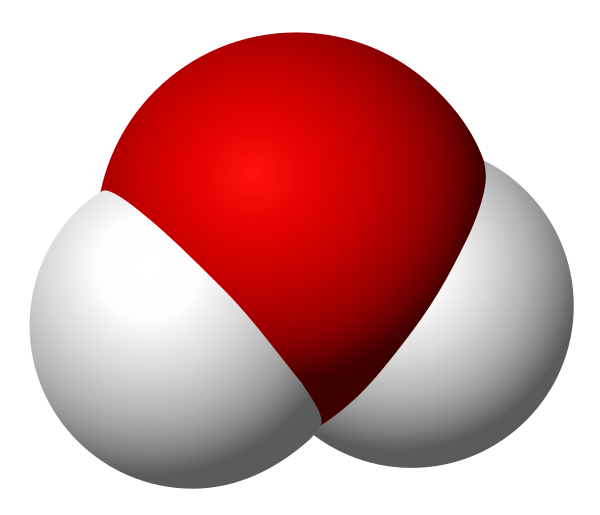
A single drop of water has millions of water molecules in it. Water molecules each have one oxygen atom (red) and two hydrogen atoms (white) connected by covalent bonds. Covalent just means they share electrons to stick together. Hydrogen atoms are positively charged and oxygen atoms are negatively charged when stuck together (dipole).


I think it’s kinda cute. I mean slap some googly eyes on that guy and it could happily star in a morning cartoon.

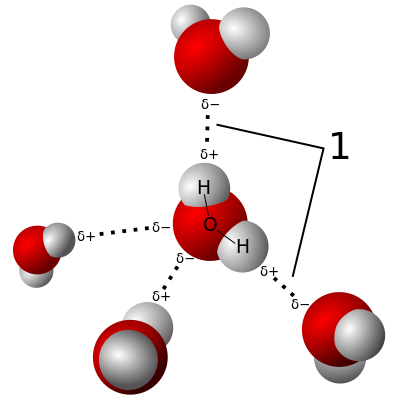
But then how do they stick together to make water? That would be hydrogen bonding. When lots of water molecules hang out together the electrical attraction from the charges make them get really close together, making them hard to get apart which raises the boiling point and makes it a liquid at room temperature. They are also constantly breaking apart and sticking back together, which give water some of its more unique qualities.


Water molecules stickin’ together. Bunny and I think the water molecules look like cartoon frog heads.

Here we are enjoying the properties of hydrogen bonding on our vacation:


Some cool water things to know:

  • Water is 11.1% hydrogen and 88.9% oxygen by mass even though there are two hydrogens. This is because hydrogens are way smaller atoms than oxygens.
  • Water is the only natural thing on earth that can be in all three states: liquid, solid and gas.
  • The water that is on earth now is made up of the same exact elements that made the water on the planet when dinosaurs were here.
  • Trees are two thirds water. So is your brain.

PHEW! Well, now we will all have a big glass of hydrogen covalently bonded with oxygen. I’m going to put a tea bag in mine.

References:

Thursday, 18 October 2012

Honk if you love geese

This post has a soundtrack!


So it seems the intro to my last post brought up some questions about geese. Good ol’ Branta canadensis. A true Canadian icon or a true Canadian pest… I guess it depends on how you feel about goose poop.

But no one can deny that the Canada Goose migration is iconic and a clear sign of fall. And it’s hard not to notice, what with all that honking and all. The CAGO (that’s its nickname in the birding world – all birds have a four letter code) has its distinctive V formation and coupled with their need to communicate during flight (click here to hear them!) and you have a sight that often stops us in our tracks to stare upwards. The wing-whooshing as they pass over is pretty cool too.

The geese are headed to the southern US, much like my in-laws, and can travel more than a 1000km a day, also much like my in-laws (family groups with goslings take longer to get there though, probably because they have to stop and pee a lot.) However I’m pretty sure my in-laws don’t feel the need to honk at things the whole way. At least I hope they don’t.

So why do the geese?

Simply, communication. They need to tell each other where to stop, changes in speed, direction – they are simply keeping everyone updated of the plans. Geese are one of the most vocal species out there - starting even before hatch. Research has shown about 13 different calls – ranging from “hey there” to “holy crap run!” to “this grass is seriously awesome, no seriously, try this patch here.” (Yes, I make up voices for birds when I’m watching them). No one wants to be the guy who took the wrong turn in Mississippi and missed the cornfield party. The V-shape is linked to communication too – everyone can see everyone, sound travels easily and changes are done quickly.

And you know that weird taking turns being the leader thing that cyclists do? (It always confuses me – you are leading, why are you letting the other guy just go ahead? It’s a RACE!) Anyway, they didn’t invent that – geese have been doing it for years. Scientists (aren’t they awesome) think that the V creates a drafting effect where the geese in behind take advantage of the air currents. Plus the geese aren’t racing, so taking turns on the hard job makes sense, unlike cyclists (seriously, you are racing guys).

Honk!

For anyone who wants more goose information here’s a link to another Canadian icon – Hinterland Who’s Who. http://www.hww.ca/en/species/birds/canada-goose.html

Dooo doo doo doo doo doooooo. 


Monday, 8 October 2012

The Birds.


We have a few different games to play in the car. A particular favourite is called Canada Flag Ahoy. It’s a complicated game where if you see a Canadian flag you have to yell “Canada Flag Ahoy” at the top of your lungs before your sister does. But driving also offers the opportunity to stare out the window and take in some of the things you wouldn’t necessarily notice and ask a bajillion questions about them in the five minute drive to school. It’s fall here now so we’ve talked about why leaves change, why the geese need to yell while flying, where all the butterflies went and if they will they see the geese when they get there. 

The girls have noticed a lot of species are on the move south this time of year, including their grandparents, and we’ve been talking a lot about which species stay, which go and how they get to where they are going. This brings me to my real topic. 

Bird Shows.

Some species gather in large numbers around this time of year to prepare for migration. I have spent a number Augusts and Septembers with a VHF receiver driving the shorelines of Lake Erie listening for my tagged Black Terns within in the hundreds staging. I’ve inspected hundreds of Great Egret legs standing on mudflats looking for the little red bands we’d put on a couple hundred kilometers away.  Birds do some significant travelling this time of year and even birds know a road trip is more fun with a buddy, or a couple of thousand buddies.

What we usually see here on our way to school are robins, blackbirds and starlings. They are putting on some impressive displays rivalling the snowbirds at the air show (and sometimes just as loud). There’s a few old trees out behind our place that are a favourite roosting spot, so luckily we get to witness quite a few bird shows. I’m sure you’ve all seen the large flocks seemingly moving as one unit, changing direction and then all suddenly landing. In late summer a number of species join flocks, they fly together, feed together, roost together and migrate together. These staging flocks can be tens of thousands of birds (although not that many fit on the trees in our neighbourhood). Nobody quite knows yet all of the hows or whys, but that doesn't make it any less stunning. 

A video of this phenomenon in starlings (as a bonus it's a nice wetland restoration story too):


And just to make this post extra awesome - did you know that the larger flocks actually show up on weather radar? And that since the discovery that the strange ghosting patterns that kept showing up on screens were actually birds migrating it’s been tracked (thank you fellow science nerds).  Now even the air force uses it to avoid collisions! Bunny was thrilled to know that you can track insects too and is planning to watch for her beloved butterflies to return in the spring (OK – it’s not that good, you can just see swarms, but we’ll pretend they are butterflies). Now instead of trying to describe all this I will let some of the ridiculously cool images speak for themselves:

Dispersal at Sunset:

Roost rings as the flocks depart:


More information and pictures here: http://www.virtual.clemson.edu/groups/birdrad/ (which is where the above images are from) 

I wonder if they play games on the way down. We should teach them Canada Flag Ahoy.

Saturday, 8 September 2012

Worm Rescue


Around here on rainy days we have to leave a bit of extra time to get to school. Not because of raincoats and boots, not because of traffic, and not because (ok, not entirely because) of jumping in puddles. It’s because of worm rescue.

If it’s been raining for a while there are usually a large number of earthworms on our driveway, which must be rescued from a potentially gruesome squishy demise from our car. The same goes for the school parking lots and the sidewalk up to school. Bunny wants to be an animal doctor (worms and insects are included in her definition of “animal”) and Beans thinks Diego ranks in the same realm as Batman (and she loves them both dearly), so not rescuing every single worm possible is unthinkable.

So the question was posed – why are all the worms out in the rain? If you think about it - they are creating a veritable buffet out of themselves for the robins and getting stepped on a lot. Those that don’t make it back to the lawns after the rain end up as worm jerky. Funnily enough, watching robins eat the worms is another favourite pastime which seems contradictory to this one but as Bunny put it “some of them are supposed to get eaten by robins, the robins won’t want them all squished”. It’s a valid point, I wouldn’t want my breakfast run over by a car first either.

So the question still stands though, why are all the worms out in rain? The original school of thought was that they came out to prevent themselves from drowning but recent research has shown otherwise. In fact, earthworms can survive several days underwater and require moisture in the soil for survival. So what is their real reason for surfacing? Migration! The surface moisture provides a quick mode of transportation for longer distances that isn’t available on sunny days. Or as Bunny put it “they have slime, they can’t slide on dry.” Though it seems worm evolution hasn’t yet caught up with the invention of pavement.

Another reason may be escaping predation – the vibration mimics that of underground predators and they surface to escape (only to be eaten by robins, so unfortunately it doesn’t always work out for them).

Even cooler? Research published in the journal Ethology showed earthworms swarming and using touch to communicate and make group decisions!

So there you have it. While I always knew the worm’s important place in terms of soil health and breakdown, I underestimated the complexity of their existence. Worms migrate, survive underwater, form herds and “research confirmed that social cues among earthworms influence behavior.” Not so different from us (well, except for the surviving underwater part – they’ve got us beat there).

I, for one, am going to treat the humble earthworm with a lot more respect from now on and perhaps rescue a few myself, even if the girls aren’t around.