Thursday, 25 July 2013

Road Trip! (with bags)

We are about to embark on a road trip.


We all love road trips except for one small snag...

Bunny gets carsick.

It sucks. I know this because I get carsick too. As a kid there was many a long trip that was interrupted by pulling over to the side of the highway so I could rid myself of lunch (or on occasion, lunch ending up in my lap). It is way worse when you try to read anything, even maps. I'll pretend this is why I get lost a fair bit. Beans does not get carsick and this is horribly unfair, but she got her dad's "I can do anything in the car, look while I read this novel without puking" gene.

So we travel with a bunch of emergency green bin bags in the van, because that's a better option than your hoodie when you can't pull over fast enough. Note: we use biodegradable green bin bags so that I don't feel guilty about leaving them in a ditch because apparently other people aren't really into the idea of driving a bag of puke around until you find an appropriate disposal can. Yes, we throw up enough in the car to have this be an actually discussion we've had. And strangely, after all that - we all still love road trips.

The setup made this one pretty obvious eh? Why does Bunny get carsick?

About 33% of people get motion sickness, which results in nausea, dizziness and vomiting. And it has nothing to do with our stomachs at all. It has to do with our ears. Yeah - Bunny didn't believe me either.

Your body's sense of balance and spatial orientation is managed by the vestibular system. It's located in the labyrinth of the inner ear (bonus points if that made you think of David Bowie). This is why when you have an inner ear infection you can get dizzy and stumbly.

Labyrinth - the ear one, not the muppet one
By user:Thomas.haslwanter (Sensesweb) [GFDL (www.gnu.org/copyleft/fdl.html) 
or CC-BY-SA-3.0 (http://creativecommons.org/licenses/by-sa/3.0/)], 
via Wikimedia Commons

That crazy mess of tubes there is why you can stay upright and move around without bonking into things. It also knows when Bunny is doing cartwheels and adjusts her brain accordingly, which is good because that is ALL THE TIME. It's also why in something like an elevator, where you can't see you are moving, you know and feel like you are.

Which is where the motion sickness comes in. In a car you are not moving, the car is moving, but your body is not. So if you look in the car you see you are not moving, but if you look out the window you can see that you ARE moving. Are you confused? Because your labyrinth is! That discrepancy ends up in your brain as a confused message and that's what causes the symptoms. The theory is that your body is trying to rid itself of a toxin it thinks is causing the confusion - so hence the tendency to rid yourself of everything and anything in your stomach. The good news is that it's usually the worst in children 2-12, so hopefully it lessens as time goes on.

Our magic equation:
Bunny + movie + ginger ale + half-dose kids gravol
+ stops to run around = no bags used on the Florida trip

There's a few things that can help - fresh air, gravol, not reading, looking at the horizon...some treat the nausea itself and some try to alleviate the confusion. Ginger and mint are said to help, and ginger is being rather thoroughly studied as a nausea treatment, which only strengthens Bunny's ongoing love of ginger ale and peppermint gum. Much to her (and Beans') delight we've also discovered focusing on a movie in the car also does the trick, along with lots of stops to breathe and run (and purchase more ginger ale).

So here's to hoping we make it to Wisconsin with limited bag use.

Friday, 19 July 2013

We ♥ Parks


This is a bit out of the ordinary for this blog, but I wanted to do a post in honour of Canada's Parks Day on July 20. I am posting this today because I will be outside with Beans and Bunny on that day and will be having too much fun to post a whole blog.

Lake Superior PP (Ontario) 2011

We've done a lot of camping and visiting in parks over the past few years with Beans and Bunny (and a bunch before that too) so I wanted to do kind of a pictorial to say thanks to parks for being awesome and providing a space for families to go and explore and learn and for nature to just be itself, with some trompling. So without further ado, here are some of our favourite park times. I've included a couple from the US too, because all parks deserve a hug and we Canadians are a sharing bunch. I hope this encourages you to go out and visit your local (or not so local) parks and show them some love.


This doesn't need a caption, it's pretty awesome
New River Gorge National River (West Virginia) 2013
Off on a hike
Sebastian Inlet State Park (Florida) 2013


Shoreline Adventuring
Killbear Provincial Park (Ontario) 2012
Bunny  Giant Bugs!
Killbear Provincial Park (Ontario) 2012
Bums in a tent
Six Mile Provincial Park (Ontario) 2009
Wetland Pondering
Six Mile Provincial Park (Ontario) 2009
Parks have handy signs so you can learn stuff!
Florida 2012
Looking up the birds we saw
Lake Superior Provincial Park (Ontario) 2011


Beautiful wetland
Lake Superior Provincial Park (Ontario) 2011

In a couple of weeks we're off to explore yet another park or two, this time in Wisconsin. And then more of Ontario later in the summer. We'll check another lake off everyone's lifetime "swam in it" list and we'll take the time to learn about the local flora and fauna. I promise there will be pictures.

Monday, 8 July 2013

Stuff in our lawn

Beans had a friend over the other day and they were playing in the backyard. They decided to pick some flowers and her friend brought a pretty little yellow one over to me. I explained that it was "birdsfoot trefoil" and she responded by telling Beans that she was lucky, her yard just had grass. They then proceeded to make a lovely bouquet out of our "lawn".

We let the hill in our backyard go pretty natural for a variety of reasons, the most prominent being that it's hard to mow a hill and we have better things to do, but also because I find a monoculture of grass boring and it gets a pretty good mix of random plants and flowers and by doing this it generally stays green and pretty and we get some visitors - bees, butterflies and all the groundhogs named Daisy. I do remove "prickles" for the sake of bare feet and the majority of the dandelions for the sake of my neighbours (OK, maybe only the ones they can see in the front).

As I have just returned from a course that involved a lot of plant ID, I'm in a vegetation ID kind of mood. So we went out the other day to figure out just what the heck is growing in our lawn this time of year. If I remember, we'll do this again later and we can see if it's different. I did not take pictures of dandelions, plantain or anything that wasn't flowering yet - so this isn't quite everything that's in there. Come fall there will be asters, goldenrod and maybe some other stuff too. I will note that a lot of this is not native to Ontario - many of these species are "naturalized", meaning they have been here for so long that they are now a part of the ecosystem. Many were introduced from Europe by settlers, either as food or decoration. This should not be confused with "invasive" which is a plant that seriously threatens the balance by taking over.

Look - there's a Bunny on the hill!
She pointed out that because this blog is called "Beans and Bunny"
that she really should be IN the pictures.
White Clover
If I was actually trying to grow grass (which I halfheartedly am in the front yard), clover is an awesome plant to have in there because it crowds out weeds and is a nitrogen fixer, so it helps grass grow. Which is why I dump clover seeds on my front lawn. Also, it's easier to grow than grass (but not as easy as dandelions).


Brief interlude for nitrogen fixation:
Nitrogen is an important part of the whole life-building process, but the plants need some way to get it from the atmosphere to a usable form and that's where the microscopic organisms come in. In some plants, in particular a lot of members of the legume family, have formed a symbiotic relationship (win-win) with bacteria call Rhizobia in their root systems. These bacteria make nitrogen into a form that the plant can use, then when the plant dies that usable nitrogen goes into the soil where it is available to other plants who aren't as lucky to have the bacteria hanging out with them. This works so well that many farmers use nitrogen fixers in their crop rotations.

SUPER AWESOME COOL FACT: Another nitrogen fixer is lightning - which by extreme heat converts atmospheric nitrogen into nitrogen oxides which are then carried to the earth by rain, where it can be used by plants as nitrates. So thunderstorms are actually fertilizing the plants in a small way. See - told you it was a super awesome cool fact.

There are a lot of cycles in nature - this one is the Nitrogen Cycle!
http://commons.wikimedia.org/wiki/File:Nitrogen_Cycle.svg
Click HERE for more Nitrogen Nerdiness and also HERE

Now, back to your regularly scheduled lawn contents:

Black Medic
Now this is one of those ones people usually try to get rid of, but I find it grows well (also a nitrogen fixer) is soft and green and low so it's perfect for rolling on (because that's what you do when you have a hill). Plus it's EVERYWHERE.
Black Medic

Birdsfoot Trefoil
The little seed pods look like birds feet, hence the name. I love when they name things after what they look like, it results in me having to make up my own names for things a lot less. This is a happy looking little plant, it growns really well, is yet another nitrogen fixer and our resident bumble population just looove it. Bees are fun to name, by the way, and that day we had Bumble, LaBumble and Cabumble (said like an explosion) (Bunny) and their friends Sally, Bob and George (Beans). With the recent decline in bees, I'm happy to give them a little safe haven on our hill.

Yellow is my favourite colour!
George doing his bumbly thing

Wild/Woodland Strawberry
OK, OK, it's small, all by it's lonesome and it's not flowering, but maybe it will and maybe we can eat it! I should hope you all know what strawberries are and their awesomeness, so there's not much more to say here.
Little tiny strawberry!

Chicory
I have always been a bit jealous of this plant as my Grandma re-named it after my sister, so even though I now know it's chicory I always still think of it as "Rachel-Flower" in my head. This is a favourite of the groundhogs named Daisy, so we have a few leaves and flowers and a lot of woody sticks. This is a super useful plant if we ever wanted to harvest it - you can eat the leaves (it's the wild cousin of radicchio and endive) and the roots are baked and ground as a coffee substitute.

Chicory/Rachel-Flower

Oxeye Daisy
I love daisies. So much so that they were the flowers at our wedding. They don't serve any purpose on the hill other than to make things happy and sunny and pretty, and they do a damn good job of that.

Pretty and sunny (and partially eaten/trampled)

Canada Anemone
Completely unrelated to the sea creatures, by the way. These are pretty and grow really well pretty much everywhere. I transferred a few of them into the garden area of the hill and now I have a ton there because they multiply by underground rhizome. First Nations used this as a treatment for wounds and sores, so it's probably pretty handy to have around.

These ones are quite nice to have around!

Daisy Fleabane
More things that look like dasies, yay!
We don't have any deer come round, but if we did they would eat this, which looks rather like an aster, but isn't.
Daisy Fleabane (lots of tiny petals) and also some more Oxeye Daisies.

Wild Carrot (Queen Anne's Lace)
If you pull this one out and break the root and take a sniff, it smells just like carrots. Which makes sense because it IS a carrot, but too woody to be edible. It does look lacy though, and there is one tiny red flower in the middle to attract insects (which you can't see on this really because I'm not very good at plant pictures).
Carrots!

Deptford Pink
Super easy to remember name because they are what they say - PINK. Tiny little guys, we have quite a few of them scattered about. Plus both Beans and Bunny love pink, so they show up in our lawn bouquets a lot.

A tiny dot of pink in the "lawn"

Motherwort
This one is really cool. It's a member of the mint family and has a long traditional medicine history. Used mostly for women for a number of reproductive issues (hence the name). It's also been used for it's calming effect, as a cardiac tonic, for insomnia and also stomach issues. We use it for looking nice against a fence, but it's nice to know that should I need whip up a uterine tonic, it's easy to get.


Curled Dock
So this is one of those love-hate plants. It can be invasive in some places, however it provides a good winter food source for our bird friends, so as we don't have a lot of it I just let it be. In googling I have discovered that you can grind up the seeds and make flour.

This one is falling over it has so many seeds!

Dead Grackle
OK, clearly this isn't a plant. But it's in the lawn and we were quite excited to find it after our decomposition talk the other day. We inspected it and noticed that the flies had moved in and there were tiny maggots on it, so it's probably in stage 3.

Grackle, stage 3
Bunny won't let me move it as she wants to keep track of the process (such a proud mama-nerd I am right now!) and informed me it would be wasting it to put it in the garbage when I told her that's what people usually do with dead things, and I do not want to be known as a grackle waster.

She even invited the neighbour over to poke it with a stick.

Helpful resources:
People in our neck of the woods who want to ID their random wildflowers in their lawn -try http://www.ontariowildflowers.com/ for figuring out what you've got.
If you want a book I would recommend Newcomb's Wildflower Guide or the Peterson Field Guide for Wildflowers (I have both on the shelf in my office).


Note: Since writing this we have buried the grackle on the hill as the neighbours dog was rolling on it.

Tuesday, 18 June 2013

The Decomposers

On Saturday we took a walk down the shore to look at a dead fish we were told was there, and it did not disappoint. Yes, we take walks specifically for dead things. Although, I know, it's a dead fish, it didn't have much to live up to really. Kids in general have such a fascination with dead stuff - it's a good way to get a close up look at some species we don't see often and also it's fun to poke stuff with a stick. And this fish was so dried out that Beans immediately asked if she could touch it with her hand, which being weird cool like that, of course I agreed to. And then Bunny couldn't be outdone so she petted it too.

Our dead fish turned out to be a Longnose Gar. A super cool prehistoric looking guy with armor-like scales and a looong mouth full of pointy little teeth. Had my camera (phone) not been both out of batteries and in the cabin I would have taken a picture, but it was both of those things, so here's a artists rendition of what our fish would have looked like alive. Now picture it with just bones for a head, dry, no insides and it's fins slightly nibbled.

http://commons.wikimedia.org/wiki/File:Longnose_gar.jpg

This did bring the questions up of where did the insides go and who is doing the nibbling? You'd expect to see all the guts dried up inside and such but it was empty as a drum. We know this because Beans thought it was funny to tap on the scales like, well, a drum. So, because this is a shoreline decomposition the main answer is probably a combo of scavengers led by one of Bunny's favourite birds - Turkey Vulture - and one of mine - Herring Gull - and then a large variety of insects and some other microscopic things we'll lump together and call "the decomposers" for now. This would be different if it was back in a forest somewhere, which would still have the vultures (they are patrolling everywhere) and decomposers but also throw in some crows, ravens and a coyote or two and subtract the gulls. And also someone's dog will roll in it.
Decomposition begins almost immediatly at death and involves two processes: autolysis, which is the body's internal chemicals and enzymes breaking down it's own tissue, and putrefaction (awesome name eh?), which is breakdown of tissues by externabacteria. This tissue breakdown releases gas which is that unmistakable "something is dead here" smell. Like when the mouse died in our wall.
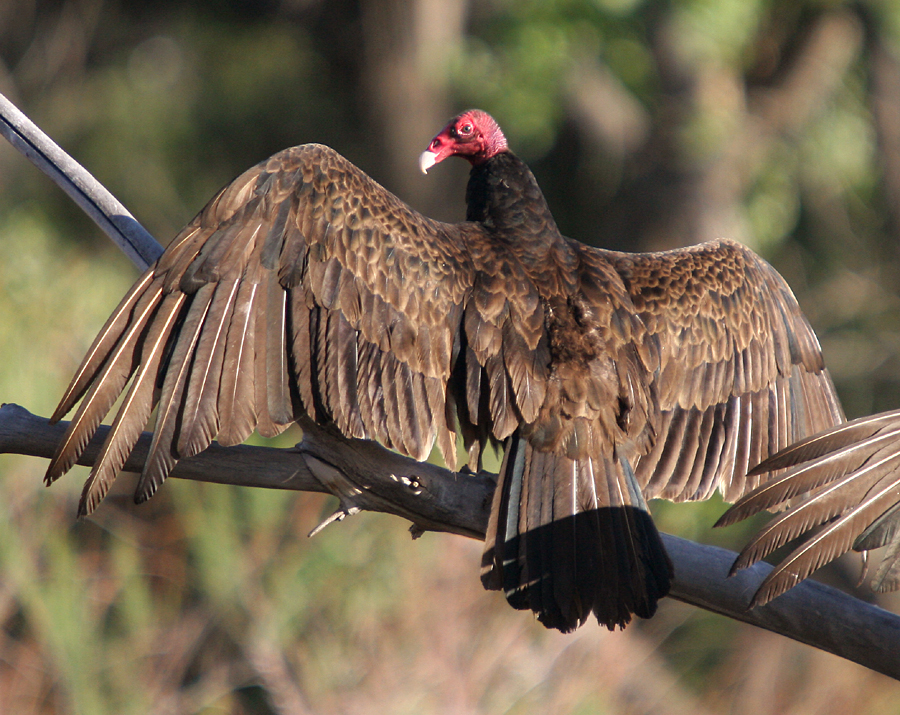
So let's start big. Turkey Vulture. Yes, it's a little weird that a seven-year-old has it as one of her favourite birds, but they are pretty cool, if not pretty. It has an incredible sense of smell, which is really rare among birds - many of which can't smell at all. They have no feathers on their head so as not to pick up bacteria when they stick their heads in a carcass (my apologies to anyone having a snack while reading this). They also have a well developed immune system, which is why they don't get the diseases we would from eating decomposing things (like salmonella, botulism, cholera...fun stuff like that). Stop eating now if you were. They like freshly dead stuff but sometimes have to wait for a bit of "softening" before they can pierce through the skin. They eat the soft bits first.

How can you not love this face?
By Mjobling (Own work) [GFDL (http://www.gnu.org/copyleft/fdl.html) or 
CC-BY-3.0 (http://creativecommons.org/licenses/by/3.0)], via Wikimedia Commons

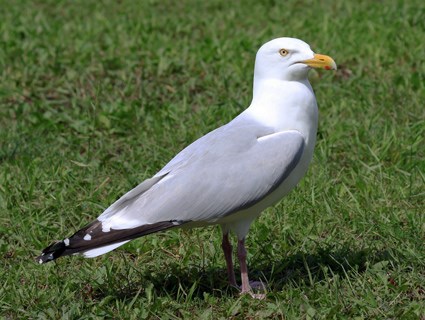
I used to work with Herring Gulls, so I've got a bit of a soft spot for them. Which incidentally is probably on my head from where they used to smack me while I was working. These are not to be confused with the smaller Ring-billed Gull, which is the one you find eating fries in the parking lot. Herring Gulls are, for the most part, seafood eaters. They also like insects, worms, eggs, chicks of other species and carrion (dead stuff) if the opportunity arises, particularly dead fish. So this guy is one of our likely suspects for eating the Gar, considering there is no shortage of them where we were.

What are you looking at? Dead fish are easy to catch.
© Laura Erickson, MN, Tettegouche State Park, June 2010

Then in come the insects. Flies and their larva (everyone's favourite - maggots!), worms, beetles - ain't no party like a dead fish party! By eating away at the fish they open it up to the microscopic stuff. Maggots are so good at this, and so specialized to eat only dead, rotting things that they are once again being used in medicine for treating non-healing wounds.

So now that the big parts have been eaten, who does the rest of the clean-up? The Decomposers. It really should be a title of a movie or something, I think something mafia-related or maybe a funny heist film. But what it's really referring to in this case is a variety of bacteria. Bacteria have a really useful purpose here by breaking down everything that didn't get eaten into simpler matter, turning our dead fish back into soil.

There are 5 stages of decompostion - Fresh, Bloat, Active, Advanced Decay and Dry/Remains. Our fish was in number five - just bones and scales. Fresh is where the scavengers come in, taking what they can for dinner. The Fresh stage is the one where the body changes colour (livor mortis), goes rigid for a bit (rigor mortis) and cools down (algor mortis) and as any good fan of CSI should know, these are key for finding out the time of death (which doesn't matter for our fish really), also you need cool in-the-air swipey computers and a bunch of random pipetting.

OK, so I debated whether or not to put this one in, but then I thought,
why not, it's only a decomposing pig.

By Hbreton19 (Own work) [CC-BY-SA-3.0 (http://creativecommons.org/licenses/by-sa/3.0) or
GFDL (http://www.gnu.org/copyleft/fdl.html)], via Wikimedia Commons

Bloat is exactly what it sounds like - a build up of gases that cause the dead thing to puff up. Caution when poking things in the bloat stage with a stick, they can indeed pop. And that's not a fun kind of piñata. This is when the insects move in too. Active Decay and Advanced Decay are the time when the decomposers are really in their element. It is basically the massive breakdown of tissue (active) and the end of that cycle (advanced) where the maggots have had their fill and move on to the couch for a nap (OK, actually they pupate) and the bacteria clean up and do the dishes. Dry/Remains is where our fish was - skin/scales, cartilage and bones - only non-edible stuff is left. The end of the food chain. The nutrients go back into the soil to be taken up into the plant roots and begin the cycle back up again. The ultimate recyclers, those decomposers. There are bacteria (and fungi and actinomycetes) to specialize in nearly everything - dead plants, dead animals, poop - it all gets broken down and reused.

It's quite a feat in teamwork. All these creatures work together to make the world a cleaner place. Now if I can just get a gull to do my laundry...


Thursday, 6 June 2013

Clouds (Sky Sheep)

So, it took some convincing to get both girls to the point where they accept that clouds are indeed made of water and not of fluff (and most disappointingly not of cotton candy, which I was able to debunk by pointing out it's lack of pinkness). I can't take all the credit - the Cyberchase weather watcher episode on fog may have helped a bit, because that's just a cloud on the ground. This doesn't explain the variability of clouds though - different shapes, degree of fluffiness (which isn't, but should be, a cloud measurement scale) and what Bunny asked about - colour.

Now, while I am not in any way a weather expert, I am a sailor. Which means weather has always been an interest, because when you are in the middle of a lake with a large metal pole you might want to know when lightning is coming (especially while in charge of other people's children who also have metal poles). I know which shapes of clouds mean a lovely day of sailing and which ones means get your butt back to shore. But what's with all the different shapes and colours if they are all just made of water? Bunny is not the first to wonder this - the first International Cloud Atlas was first published in 1896 (not to be confused with that recent movie that really has nothing to do with clouds at all).

The colour thing is pretty simple actually - density. Because clouds are made of water or ice crystals they break up light on it's way through which combine to make white (all light colours together make white - which by the way doesn't work in paint or playdough, that makes weird grey-mud-brown). When the clouds get thick or piled up then the light doesn't go all the way through and it looks darker - so nothing really changed composition wise, there's just more of it. If you get a whole bunch of clouds together they can also shadow each other creating an even darker or variable look.

Cool Aside Thing: When the light doesn't make it all the way through the water droplets in the atmosphere and bounces around in them, it breaks up into individual colours and we get rainbows. The water acts like a prism (think Dark Side of the Moon album cover but with a water drop) and reflects the light back at us all pretty and happy.

Now, shapes. This has also to do with density and also where they are in the atmosphere. I have borrowed this handy kid-friendly cartoon chart for some shape basics:

http://eo.ucar.edu/webweather/cloud3.html

See that tall puffy guy there on the right? He's the one that tells you to get your boat to harbour and make some popcorn for a light show. The other guys are pretty friendly. Now, before we get into any discussion about the above I'd like to put a disclaimer for any meteorologists reading this - I know there are sub-types and jargon and more classifications than this but we're not going to go there, ok? OK! There is an awesome cloud poster HERE from Environment Canada though if you want a bit more detail or just a cool ID poster for your wall to go next to your bird one.

A bunch of the names there are combos of each other which can't possibly be a coincidence, so here's why:
Cirro: curl, high
Strato: layer
Cumulo: heap
Alto: mid 
Nimbo: rain, precipitation    

So see - our cumulonimbus thunderbuddy there just means "heap of rain" cloud. Which is actually a pretty accurate descriptions of our last few weeks here, in which I sailed boats in my office parking lot. Today was very gray so it's a sky full of stratus, which decided to start raining right when soccer started, so I suppose if I look at my list below they were nimbostratus, but that's not fair because you haven't read that far ahead and now I'm cheating.

Quick overview of the main cloud types:

Stratus
These are the flat gray clouds that often make up what we would just call a "gray day" - no sky visible at all. Like a sky fog - covers everything. Sometimes they drizzle.

Nimbostratus
Dark gray and rainy looking, and often are rainy and that's why they are nimbos - that continuous light or steady rain that lasts a while. This was soccer today - steady (and windy, but we're not doing wind).

Cirrus
Wispy clouds that get blown around like streamers. Way up high and these are happy nice weather clouds. If you've got these your picnic is A-OK.

Happy picnic clouds
http://www.ec.gc.ca/meteoaloeil-skywatchers/default.asp?lang=En&n=5A0D647D-1

Altocumulus
Gray and poofy. They can mean thunderstorms are coming later, particularly in the summer.

Altostratus
Gray and cover the whole sky, but higher than the stratus ones. More rain forebearers.

Cirrocumulus
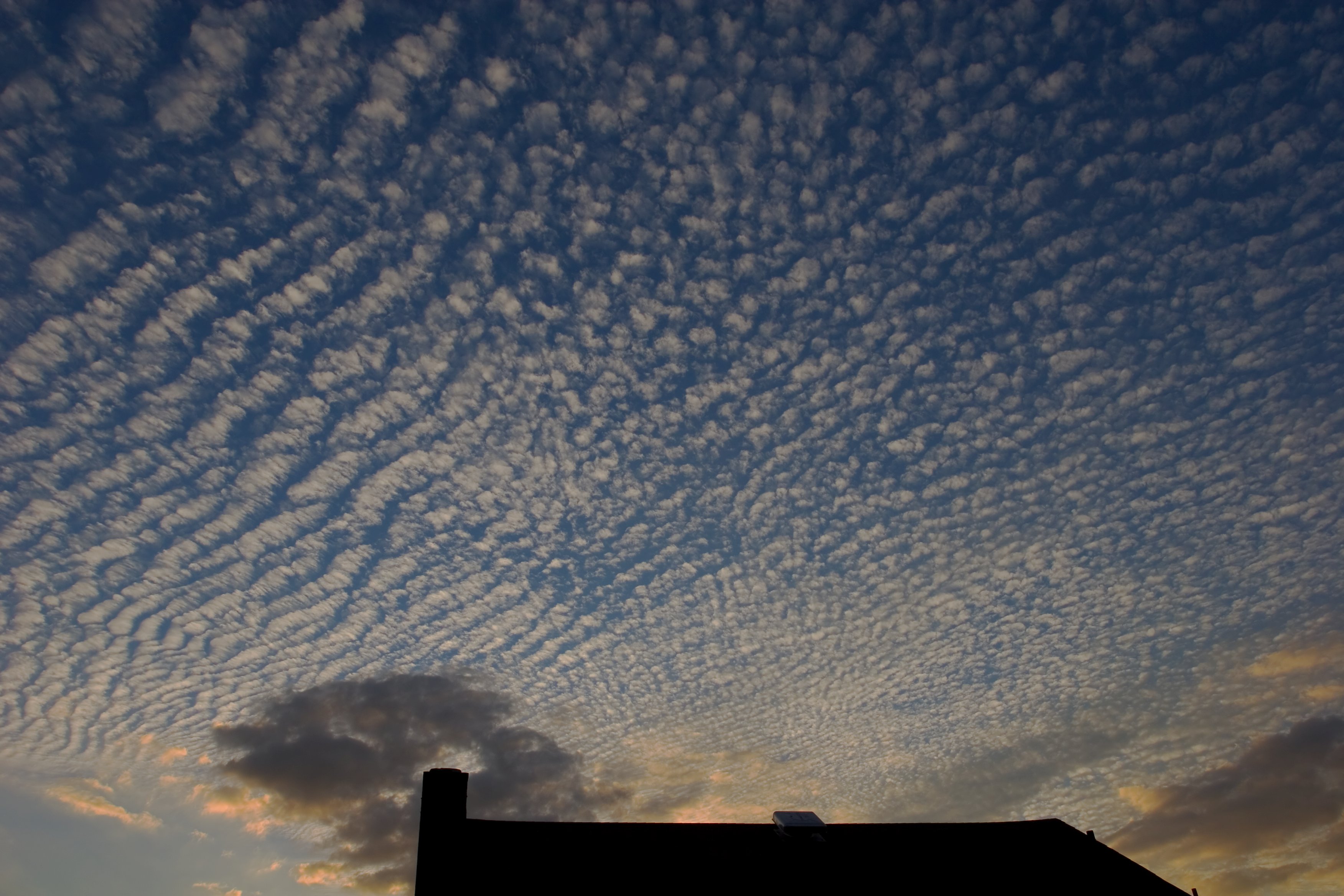
Little puffballs, like someone flung a bunch of cotton swabs up there. Sometimes they look like fish scales in which case you can call it "mackerel sky". I have no idea why a mackerel, it does seem an odd fish to choose. I feel like for here we should use "trout sky" or "bass sky". Maybe "salmon sky".

Fishy sky
http://weather.ou.edu/~smglenn/cirrocumulus.jpg


Cirrostratus
Really thin white clouds covering the entire sky.


Cumulus
These are your lying on your back looking at shapes clouds. Big, puffy and shaped like dragons, trains, and sheep (I really like sheep). The only bad thing about these guys is sometimes they get together and can turn into the next ones, which is awkward if you are doing your cloudwatching far from shelter.

Sky Sheep!
http://www.ec.gc.ca/meteoaloeil-skywatchers/default.asp?lang=En&n=5A0D647D-1


Cumulonimbus
Thunderstorm! Big and tower or anvil shaped. The bottom is dark gray, and sometimes you can see the sheets of rain coming down (and towards you). The condensation of all that water produces energy and then we get lighting, thunder and tornadoes. If you see this one remember to put down your deck umbrella.

You've been THUNDERSTRUCK
http://science.nationalgeographic.com/science/photos/clouds/#/cumulonimbus-cloud_910_600x450.jpg

Now, don't get me wrong, I love a good thunderstorm in the right situation. That situation is not on a boat with a large metal pole or in a small tent that is falling over, because I've tried both of those and I don't recommend them. I prefer a cup of tea and being on the inside of a large window.

Sunday, 2 June 2013

Itchy, itchy, scratchy, scratchy


It is middle of "bug season" here and we were outside the other day, enduring our weekend dose of biting, and we noticed that some of the mosquitoes were big, some were little, and some of the things biting us were actually flies.

So - who is actually biting us?

Biting insects are the source of a perverse sort of pride here in Ontario. While obviously they are a big, itchy, swarmy, bitey pain in the bum, there is a rite of passage to surviving the spring bug season and so year after year we sit at campfires and tents in the spring and early summer smacking ourselves and keeping the good people at Deep Woods and AfterBite in business.

While we joke about the mosquito being our provincial bird, we don't have that many species comparatively. We have about 80 species in all of Canada - and I know you are thinking that's a TON, but it's not. There are about 3000 species in the world, and with insects you have to say "about" when talking about numbers because there's no way we know them all and they have such minute differences that scientists constantly figure out what they though was one species is actually two or three or seven. Three of those 80 are exotic species, which means somewhere along the line mosquitoes decided that we didn't have enough and started hitching rides here (probably larvae in imported things with water). Ontario wins for most species out of the provinces with about 64, Quebec is runner up with 50 and BC next with 46. Go Ontario!

Mosquitoes have been around a LOOOOONG time. They show up in fossils around 89-99 million years ago. Yes, trapped in amber and no, so far they don't have cloneable dinosaur blood in them.

Crazy thing - not all northern mosquitoes eat blood. Some keep enough from their larval eating that they don't need to or they eat other things - Wyeomyia smithii breeds only in the water in the pitchers of Purple Pitcher Plants (Sarracenia purpurea) and the larvae preys on the even smaller organisms right there in that water. And in those that do require a blood meal, it's only the females that bite (Girl Power?). Both males and females eat sugar (mmmmm sugar) usually from flowers, and then in some species the females are the blood suckers to gain extra nutrients for egg laying.

They are attracted to carbon dioxide, so unless we figure out a way to breathe that doesn't involve expelling that we're pretty much always going to be a target. So once they land on us the proboscis (long bitey bit) injects a special saliva which prevents clotting and that's what we react to. Bunny was quick to point out that butterflies also have a proboscis, but their is used for only for flowers (good) and not people (evil) and is seriously not impressed with the idea of bug saliva being injected into her and an impressive "ugh" face was made. Beans wasn't really paying attention as she was busy scratching the giant bite on her neck.

I'm not posting all 80 mosquito species - but here's a few (I have made all the pictures in this post small so as not to disturb people with giant insects in their face):

Ochlerotatus triseriatus
Eastern Treehole Mosquito
Copyright © 2009 Ilona L.
bugguide.net

Culex pipiens
North American House Mosquito
photo credit
Anopheles walkeri 
 Permanent Marsh Mosquito
© Tom Murray

If you want to see more (and why wouldn't you want to see more!) check out - Family Culicidae - Mosquitoes

But the thing is here, with the biting and the buzzing and the hey hey, it's not just mosquitoes. The Blackfly is a famous Ontario resident, it's even got it's own song (link for the benefit of those who don't know about blackflies picking their bones in north Ontar-i-o-i-o, in north Ontar-i-o). There are 1250 species of blackfly worldwide (everywhere except Antarctica) and we proudly have 162 in Canada, in every single province - although BC tops the chart this time with 81. Nova Scotia is last, but I feel this means they win, with 13. Same deal - only females bite and everybody eats plant nectar.

Simulium sp.
Black Fly
© Tom Murray

And we're not done there. Here's some other stuff that bites, and still, only the females bite (it's an egg thing):
No See Um (Biting Midge) - these fit through screens, the little buggers
Copyright © 2011 tom murray
bugguide.net


The scourge of canoers feet everywhere - DEER FLY
Copyright © 2010 Stephen Luk
bugguide.net


Horse Fly - these tend to circle our heads while swimming causing much splashing and dunking
Copyright © 2012 tom murray
bugguide.net
I know, it looks like a housefly right? WRONG - it BITES YOU and is a Stable Fly
Copyright © 2006 Stephen Luk
bugguide.net


One that does not bite:

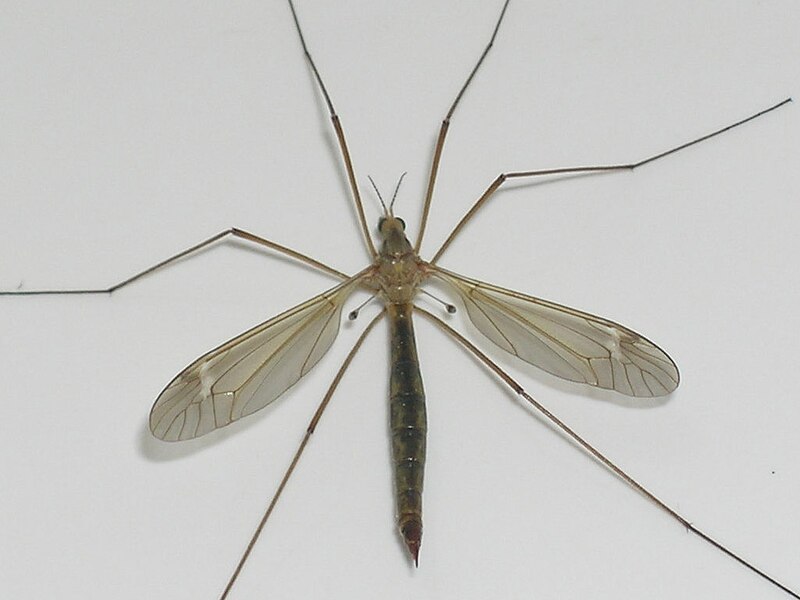
This guy I feel sorry for. He's a Crane Fly, but often gets mistaken for a giant mosquito and gets smacked anyway. He doesn't bite, he just wants to hang out and eat some nectar (and some crane fly larvae actually eat mosquito larvae!). New PSA slogan: Check before you Swat, he probably wouldn't even land on you but they do seem to like to hang out in doorways and on screens.

Please don't swat me!

Now, after all that discussion on how much it sucks that there are biting things out there when all we want to do is relax by the lake and have a marshmallow or six, it should really be pointed out that they all do serve a greater ecological purpose. They are a really important food source for a number of birds, dragonflies, bats, fish and assorted amphibians. I'm going to look at it as donating blood to a good cause.


More Mosquito Material:
http://bugguide.net/node/view/169
http://www.howstuffworks.com/zoology/insects-arachnids/mosquito.htm
http://www.wildspecies.ca/wildspecies2010/results-insects-mosquitoes.cfm
http://www.wildspecies.ca/wildspecies2010/results-insects-blackflies.cfm?lang=e


Friday, 24 May 2013

Worm Sense

I've been asked a couple of times whether Beans and Bunny know that I'm writing about them and their never ending outdoor questions. The answer is - yes, they do and they have been quite involved in the whole production since the beginning. They've now started blatantly suggesting topics for me. In fact, Bunny started her most recent question by saying "Hey Mum! I've got a blog post for you...". It's a good question too - how do worms know where they are going if they don't have eyes? And although she ended up basically answering her own question - guessing "vibrations" when she stopped to think about it a bit - there was still quite a bit to look up and discuss.

I know I've already written about worms, but she's rather fond of worms so we talk about them a lot. We also pick them up, talk to them, pet them and rescue them. We do this with potato bugs too (and they had breakfast with us once) but that's a whole other story.

The following picture should take some of us back to Grade 11 science class (or was it grade 10? or 12? It was a long time ago in the olden days of plaid and army boots) where we dissected formaldehyde soaked earthworms. I think this was one of my first inklings of my future career choices as I thoroughly enjoyed taking apart the worms and in fact did several, helping out my more squeamish classmates. I ended up taking several physiology classes in university where I took apart a variety of dead vertebrates and invertebrates and my first biology job was in an avian energetics lab where I dissected birds for 8 hours a day. If anyone needs a bird separated into all it's individual parts - I'm your girl!

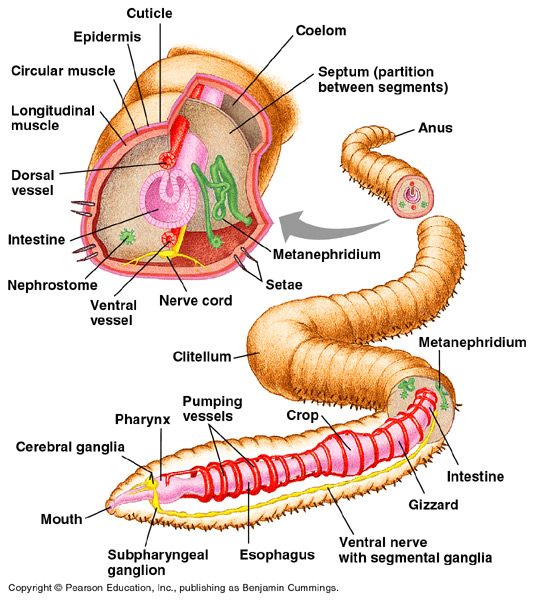
But this isn't about how cool the insides of animals are (and I fear I may be making myself sound rather macabre) this is about worms. So here's a worm's insides:

Betcha didn't know worms were so complicated!
http://www.sas.upenn.edu/~rlenet/EarthwormAnatomy1.jpg

So worms have a lot of things! Notice anything they don't have? Eyes, ears and nose. That's 3 of the 5 senses missing - so they have to get by on touch and taste.

But they do have a mouth there and over there mouth is a lobe (prostomium - not in that picture) that closes it up but also has receptors to sense what's going on around it. This is what they use to feel their way around the soil. They also have a nerve cord running down their body with a larger part near the mouth, which acts as a "brain" (cerebral and subpharyngeal ganglia). This controls not only movement and digestion but also coordinates the senses in the body - they have touch, light, vibration and chemical receptors along their entire body - so Bunny was right about the vibrations. These receptors allow them to sense changes in acidity, humidity, touch and chemical composition - equivalent to our sense of smell and taste, even though there's no nose or tongue. Very key in determining the difference between "food" and "not food". Imagine if you had no sight, taste or smell - you'd have to just go around randomly eating things hoping some of it was actually food, which could be rather disastrous.
I think the coolest of all though is light sensitivity - there are light sensitive receptor cells on the body, so it does indeed know if it's underground or not. They can tell the intensity of the light and instinctively move away from strong light. The receptors sense if they are getting close to the surface and how strong the light is to help them determine if it's safe to go up (rain, night) or not (sunny day) which makes worms and vampires rather similar in their outdoor preferences, although I don't know if vampires travel in the rain so perhaps worms have an advantage.

Extra cool: these receptors are being studied in nematodes (roundworm), and they may be the precursor to the vertebrate rod and cone system of vision, which would be amazing because then this molecular similarity is in species over 540 million years ago.


Which means my eyes would be related to an ancient nematode. Awesome.


How we learned about worms:
http://cronodon.com/BioTech/Earthworm_NS.html
http://animal.discovery.com/worms/earthworm-info.htm
http://www.naturewatch.ca/english/wormwatch/resources/anatomy.html
http://www.naturewatch.ca/english/wormwatch/about/anatomy.html
http://faculty.washington.edu/chudler/invert.html